
Summary
On April 15, 2026, All-over-IP & AI 2025 hosted the online conference “Data management for the modern digital enterprise: platforms, tools and industry cases.” The program focused on practical approaches to corporate data management, digital platforms, AI and the tools that help organizations work with data more consistently.
Gleb Cheprasov, Lead Data and Artificial Intelligence Architect at Avdyushin Consulting Group, gave a talk titled “From incidents to knowledge: how agentic and expert AI systems accelerate work with data across domains.” The topic sits at the intersection of data platforms, SRE, MLOps, LLMs, AI agents and digital system architecture.
For ACG, this is not only a discussion about AI tooling. It is an engineering question: how to connect data, context, rules, expertise and operational workflows so that teams can understand what is happening faster and make decisions that can be reused and improved over time.
From incidents to knowledge
An incident in a digital system is rarely isolated. It usually brings together signals from many places: logs, metrics, product events, infrastructure changes, user feedback, analytics results, documentation and the experience of the team. The operational challenge begins when these signals remain fragmented and the findings from each investigation are not captured as reusable knowledge.
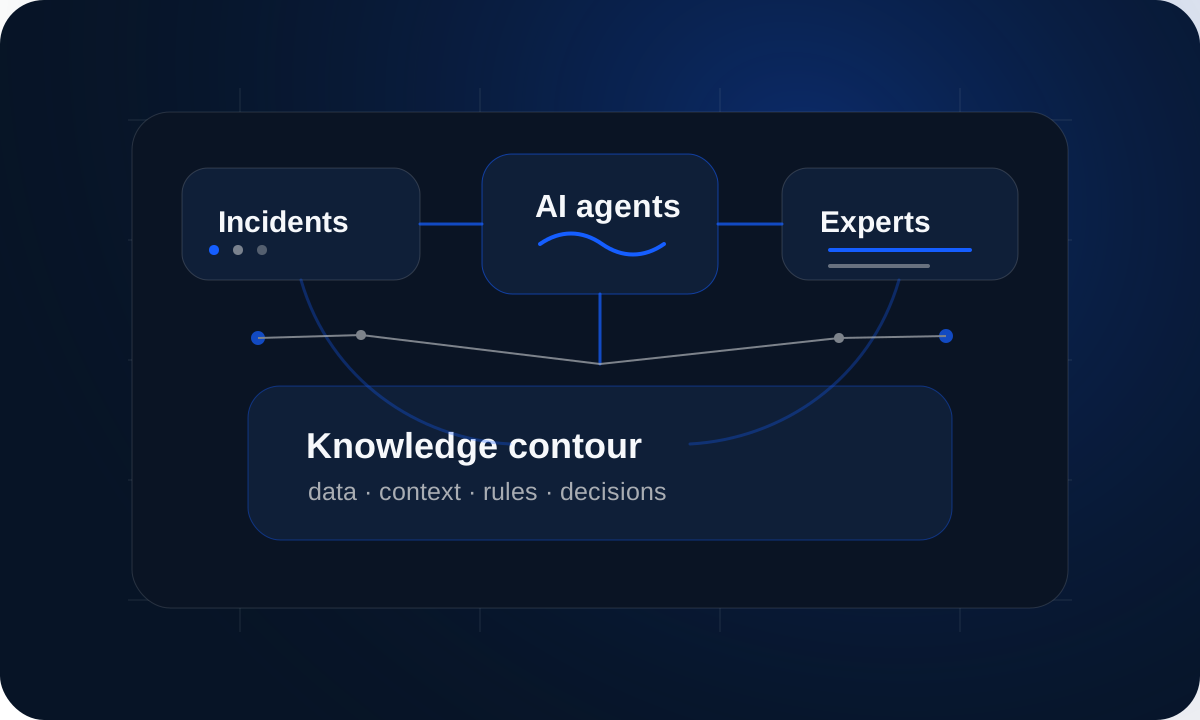
Moving “from incidents to knowledge” means changing the operating model. A team does not only react to an event. It also preserves the context: which symptoms were observed, which hypotheses were tested, which rules applied, which data mattered and what decision was made. Over time, this creates a knowledge layer that can support the next similar case.
Expert systems are useful because they can formalize domain rules, constraints and causal relationships. Agentic AI systems can add the ability to collect context, call tools, form hypotheses, connect data across systems and suggest next steps for verification. The goal is not to replace experts. The goal is to help experts find relevant evidence faster and keep a clearer record of reasoning.
Why this matters for a digital enterprise
A modern enterprise often runs through a mix of digital platforms, integrations, internal services and analytics environments. As that landscape becomes more complex, the root cause of a problem may be split across systems: one tool shows the symptom, another stores the data change, a third contains historical context, and a senior engineer or analyst knows a rule that has never been written down.
Agentic and expert systems are valuable in this environment because they reduce manual search, connect technical and business events, accelerate initial diagnosis and make expert conclusions easier to reuse. This is relevant not only for SRE and infrastructure operations, but also for data quality, MLOps, analytics, product delivery and process automation.
The practical value appears when AI is part of a real data workflow, not just a chat interface. That requires reliable data sources, access control, observability, quality rules, auditable actions, human oversight and a clear integration architecture. Without this foundation, AI remains a separate experiment. With it, AI becomes part of the operating system of data work.
What this says about ACG’s approach
For ACG, topics like this are closely connected with an engineering view of digital systems. Data, architecture, AI and operations should not be designed in isolation. Durable outcomes come from connecting them into a system with clear responsibilities, constraints and practical business purpose.
Gleb’s talk reflects this view well. Agentic AI and expert systems are not treated as fashionable labels, but as tools for connecting events, context and organizational expertise. This is especially important for companies that already have data, platforms and monitoring tools, but want to move from fragmented reaction to structured operational knowledge.
Materials
The event page, presentation deck, talk recording and the All-over-IP & AI Forum page are available through the links in the frontmatter of this file.